




Ultimate Amazon Freight Guide: Ship from China to FBA in 2026
Are your Amazon profit margins bleeding due to peak-season warehouse delays, hidden volumetric weight fees, or sudden FBA cargo rejections when importing from China?
You spend months negotiating with Chinese suppliers, only to watch your freight get stuck in customs or penalized by Amazon for non-compliant pallets. Every day your inventory sits at the port, your organic ranking drops, and your competitors steal your buy box. The stress of managing unpredictable supply chains, dealing with confusing customs documents, and fighting for container space is crushing your business scalability.
It does not have to be this way. Partnering with a specialized China-based FBA freight forwarder transforms your logistics from a liability into a competitive advantage. In this comprehensive guide, we reveal the exact frameworks to ship your freight securely via air, sea, and rail, avoid hidden port fees, and secure 100% customs clearance so you can focus on scaling your brand.
What is Amazon Freight? (And Why Cross-Border Sellers Need More)
Amazon Freight is a domestic transportation network allowing shippers to use Amazon’s 53-foot trailers for truckload shipments within the US and Europe. However, international sellers importing from China require comprehensive cross-border logistics, including export customs clearance and ocean freight, before accessing this domestic network.
Many overseas buyers misunderstand the term Amazon Freight. While Amazon offers highly efficient domestic trucking for local businesses, it does not handle the complex process of picking up goods from a factory in Shenzhen, exporting them through Chinese customs, and moving them across the Pacific Ocean.
To bridge this massive gap, you need an international freight forwarding partner. A dedicated forwarder acts as your on-the-ground supply chain manager in China. We consolidate your shipments, prepare the Commercial Invoice and Packing List, handle the Bill of Lading (B/L), and manage the long-haul transit. Once your cargo clears destination customs, we seamlessly inject it into Amazon’s domestic fulfillment network or local delivery fleets like UPS and FedEx.
Amazon Freight vs. Amazon Global Logistics (AGL): Key Differences
If you sell on Amazon, you have likely heard of Amazon Global Logistics (AGL). AGL is Amazon’s in-house ocean and air freight program designed to move inventory from China directly to FBA centers. So, why do top-tier sellers still prefer independent freight forwarders?
The answer comes down to flexibility and control. AGL operates on a rigid system. If your cargo does not strictly meet their preprocessing requirements, or if you need to split shipments between Amazon FBA and a third-party logistics (3PL) warehouse for your Shopify store, AGL becomes highly restrictive. Furthermore, AGL often requires payment upfront or directly deducts from your Seller Central balance, offering little room for cash flow management.
Working with an independent FBA logistics provider gives you tailored routing. We offer customized credit terms, free warehousing consolidation in China (allowing you to group products from multiple suppliers), and the agility to reroute cargo if a specific FBA warehouse is congested. You get a dedicated account manager, not an automated support ticket system.
How to Choose the Right Freight Forwarding Channel to Amazon FBA?
Selecting the correct shipping channel dictates your profit margins. Here is how to strategically route your cargo from China based on urgency and volume:
-
Air Express (DHL/UPS/FedEx): Best for small, urgent shipments under 100kg. Delivery takes 3-5 days. It is the most expensive method but crucial for product launches or preventing immediate stockouts.
-
Air Freight (Air Cargo to FBA): Ideal for medium-weight shipments (100kg – 500kg). Goods are flown to the destination airport, cleared through customs, and delivered to Amazon via local trucks. Transit time is typically 8-12 days.
-
Sea Freight (FCL & LCL): The backbone of Amazon logistics. LCL (Less than Container Load) is used when your goods do not fill an entire container. FCL (Full Container Load) is the most cost-effective method for high-volume sellers. Ocean freight takes 25-40 days but slashes your shipping costs by up to 70% compared to air.
-
Railway (China-Europe Freight Train): Exclusive to European sellers. The railway offers a perfect middle ground—faster than sea freight (approx. 18-22 days to the EU) and significantly cheaper than air freight.
Step-by-Step: How to Ship Freight from China to Amazon FBA
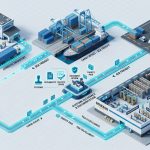
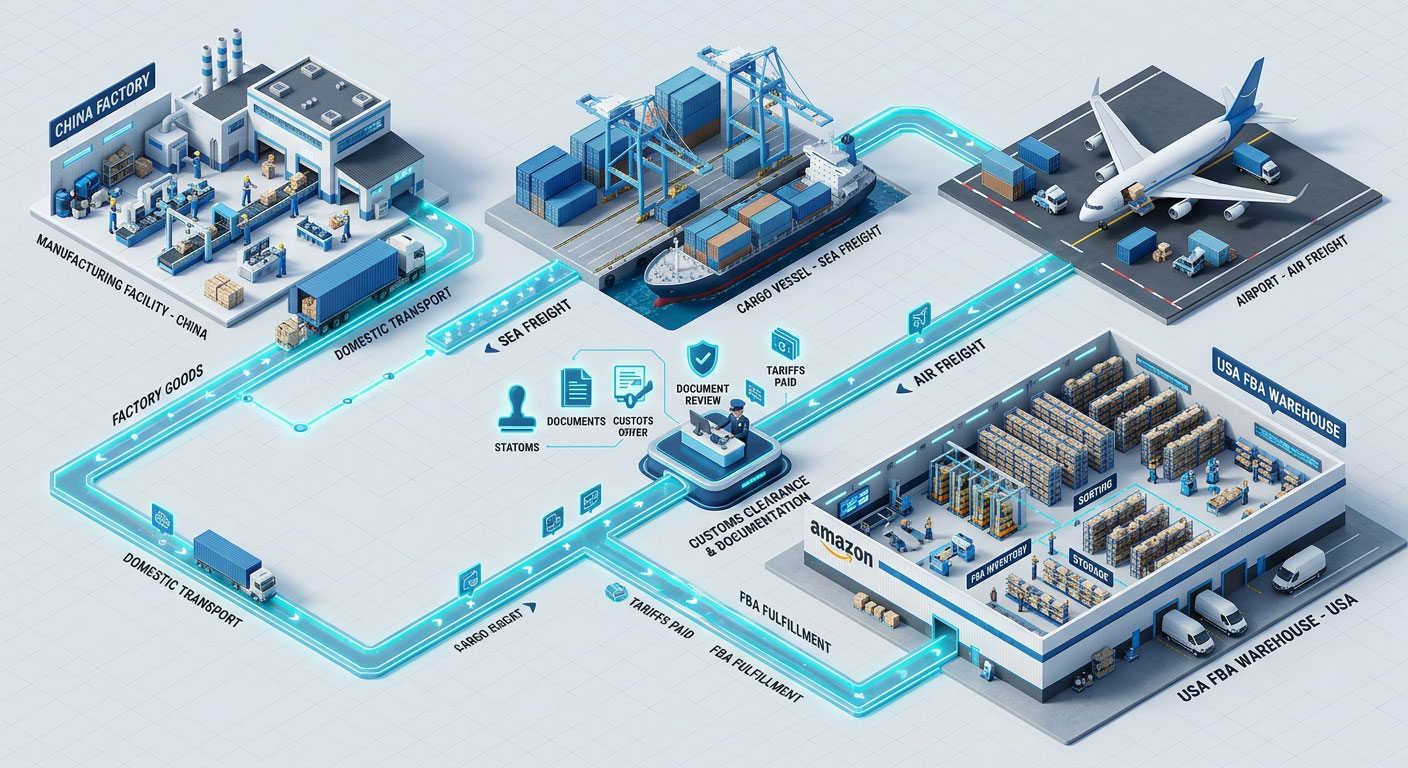
To ship freight from China to Amazon FBA, you must follow five exact steps: supplier pickup, China export customs clearance, international air or sea transit, destination import clearance, and final mile delivery to the assigned FBA fulfillment center using compliant pallets.
-
Cargo Consolidation: We pick up your products from your manufacturer (e.g., in Guangzhou or Yiwu) and bring them to our local warehouse. Here, we can verify labels and consolidate multiple orders.
-
Export Customs Clearance: Our Customs Brokerage team files the necessary export declarations with Chinese Customs, ensuring your factory possesses the correct export licenses.
-
Main Transit: Your cargo is loaded onto an aircraft, ocean vessel, or freight train. We issue the tracking details and manage the carrier relationship.
-
Import Customs & Duty Payment: Upon arrival at the destination port (e.g., Los Angeles or Rotterdam), our local brokers clear the goods. We pay the import duties and taxes directly to authorities.
-
FBA Appointment & Delivery: We secure a delivery appointment via Amazon’s Carrier Central portal. Local trucks transport the palletized goods directly to the designated FBA warehouse.
Understanding FBA Packaging and Pallet Requirements
Amazon maintains ruthless standards for inbound shipments. A single misstep in packaging can lead to your freight being rejected at the dock, resulting in thousands of dollars in return shipping and repalletizing fees.
First, individual cartons must not exceed 50 lbs (22.5 kg) unless they contain a single oversized item. Cartons must not measure more than 25 inches on any side.
When your goods arrive at the destination port, they usually need to be palletized before Amazon accepts them. For the US market, Amazon requires standard GMA wooden pallets measuring 40″ x 48″. For Europe, standard Euro pallets (120cm x 80cm) are mandatory. Pallets must be strictly heat-treated (ISPM-15 compliant) and cannot exceed 1,500 lbs in total weight or 72 inches in height.
💡 Expert Tip: The “Floor-Loaded” Trap
Many new sellers attempt to save money by shipping floor-loaded containers (boxes stacked without pallets) directly to FBA. While Amazon does accept floor-loaded containers, they require strict stacking patterns and special dock appointments, which are notoriously difficult to secure during Q4. We highly recommend utilizing our local port warehouses to palletize your loose cartons before final delivery. This guarantees fast, rejection-free FBA check-ins.
Incoterms Explained: Why DDP is the Best Choice for Amazon Freight
When negotiating with your Chinese supplier, you will encounter Incoterms like EXW (Ex Works) or FOB (Free on Board). These dictate where the supplier’s responsibility ends and yours begins. However, the most critical term for Amazon sellers is DDP (Delivered Duty Paid).
Under a DDP freight forwarding agreement, we handle the entire process from door to door. We cover the export clearance, main transit, import customs, and pay all applicable duties and taxes on your behalf.
Why is DDP essential for Amazon FBA shipping? Amazon explicitly states they will not act as the Importer of Record (IOR) for your shipments, nor will they pay any customs duties. If your cargo arrives at customs with unpaid duties (such as under a DAP/DDU term), it will be blocked. A DDP service ensures your freight moves seamlessly through borders without you having to register for a local tax ID or deal with surprise customs invoices.
The Volumetric Weight Trap: How Your Freight Costs are Calculated
Volumetric weight determines your shipping cost by comparing the actual weight against the package size. For air freight, the standard formula is 1 CBM equals 167 kilograms. Carriers will always charge based on the greater value between actual weight and dimensional weight.
Understanding Volumetric Weight (also known as dimensional weight or DIM weight) is the single most important factor in controlling your logistics budget. Many sellers are shocked when their 50kg shipment is billed as 100kg.
Here is how the math works:
If you ship highly dense products (like iron kettlebells), you will be charged by the actual gross weight on the scale.
However, if you ship light, bulky items (like plush toys or pillows), the carrier calculates the space your boxes take up.
-
Air Freight Formula: 1 Cubic Meter (CBM) = 167 kg.
-
Sea Freight (LCL) Formula: Often calculated as 1 CBM = 300 kg to 500 kg, depending on the route and forwarder.
If your plush toys weigh 50kg but take up 1 CBM of space on an airplane, the airline will bill you for 167kg. As your forwarder, we audit your factory’s carton dimensions and suggest compression packaging techniques to dramatically reduce your volumetric footprint.
Top 3 Hidden Costs in Amazon Freight (And How We Avoid Them)
The freight forwarding industry is notoriously opaque. Unprofessional forwarders often lure buyers with rock-bottom ocean freight rates, only to hold the cargo hostage at the destination port with fabricated local charges. Here are the top three hidden costs you must watch out for:
-
Demurrage and Detention (D&D): If your container sits at the port beyond the allotted free time, the port and shipping line charge massive daily penalties. We avoid this by pre-clearing your cargo while it is still on the water and dispatching trucks immediately upon vessel arrival.
-
Customs Examination Fees: Customs agencies randomly select containers for X-ray or intensive physical exams. If your paperwork is messy, your risk of examination skyrockets. Our rigorous document auditing drastically lowers your inspection rate.
-
Forklift and Tailgate Fees: Some forwarders do not include the physical labor costs of unloading your goods at the destination warehouse. We operate on a strict all-in pricing model.
Our DDP quotes are final. The price you see on the invoice is the exact price you pay to get your goods safely onto Amazon’s shelves.
Case Study: Slashing FBA Freight Costs by 30% for a US Seller
📊 Case Study: The Hybrid Logistics Strategy
Client: A mid-sized home goods brand based in Texas, importing $500k of inventory annually from Shenzhen.
The Problem: The client relied entirely on Air Freight to prevent Amazon stockouts, destroying their profit margins due to high volumetric weight charges on their bulky items.
Our Solution: We audited their sales velocity and implemented a “Hybrid Transit Plan.” We split their monthly production output: 20% was shipped via Air Freight to maintain immediate inventory levels, while the remaining 80% was routed via expedited Ocean Freight (Matson fast boat).
The Result: By utilizing fast ocean shipping and handling the palletization at our Los Angeles facility before FBA injection, the client maintained a 100% in-stock rate while reducing their overall annual freight spend by 32%.
FAQ about Shipping from China to Amazon FBA
Do I need a customs broker to ship to Amazon FBA?
Yes, if you are shipping internationally. Amazon will not clear customs for you. When you use our DDP freight service, our in-house customs brokers handle all import declarations, duty payments, and compliance checks on your behalf.
How do I get an FBA delivery appointment?
You do not need to do this yourself. Once your shipment clears destination customs, our dispatch team uses Amazon’s Carrier Central system to secure an Advanced Routing Notification (ARN) and schedule a strict delivery window for our trucks.
Can my Chinese supplier ship directly to Amazon FBA?
They can, but it is highly risky. Factories are experts at manufacturing, not logistics. They often misunderstand FBA labeling rules or use cheap, unreliable couriers that cause customs delays. Using a professional forwarder ensures strict quality control before the goods leave China.
Ready to Ship? Get Your Customized Amazon Freight Quote Today
Stop letting unpredictable freight costs and customs headaches eat into your Amazon profits. Whether you need a 50kg urgent air shipment to Los Angeles or a full container routed to Germany, our dedicated logistics experts are ready to build a reliable, cost-effective supply chain for your brand.
Stop guessing your landed costs. Contact us now with your product name, estimated volume/weight, and destination FBA zip code, and our team will provide a transparent, all-in DDP freight quote within 2 hours. Let us handle the logistics so you can focus on dominating your niche.